If you’ve tried to see a primary care doctor in Texas lately, you already know the problem. The earliest appointment is three weeks out. When you finally get in, you have fifteen minutes, and most of that goes to the medical assistant clicking through screens. You leave with a prescription and a follow-up that’s another two months away. Whatever you actually wanted to talk about either didn’t come up or got pushed to “next time.”
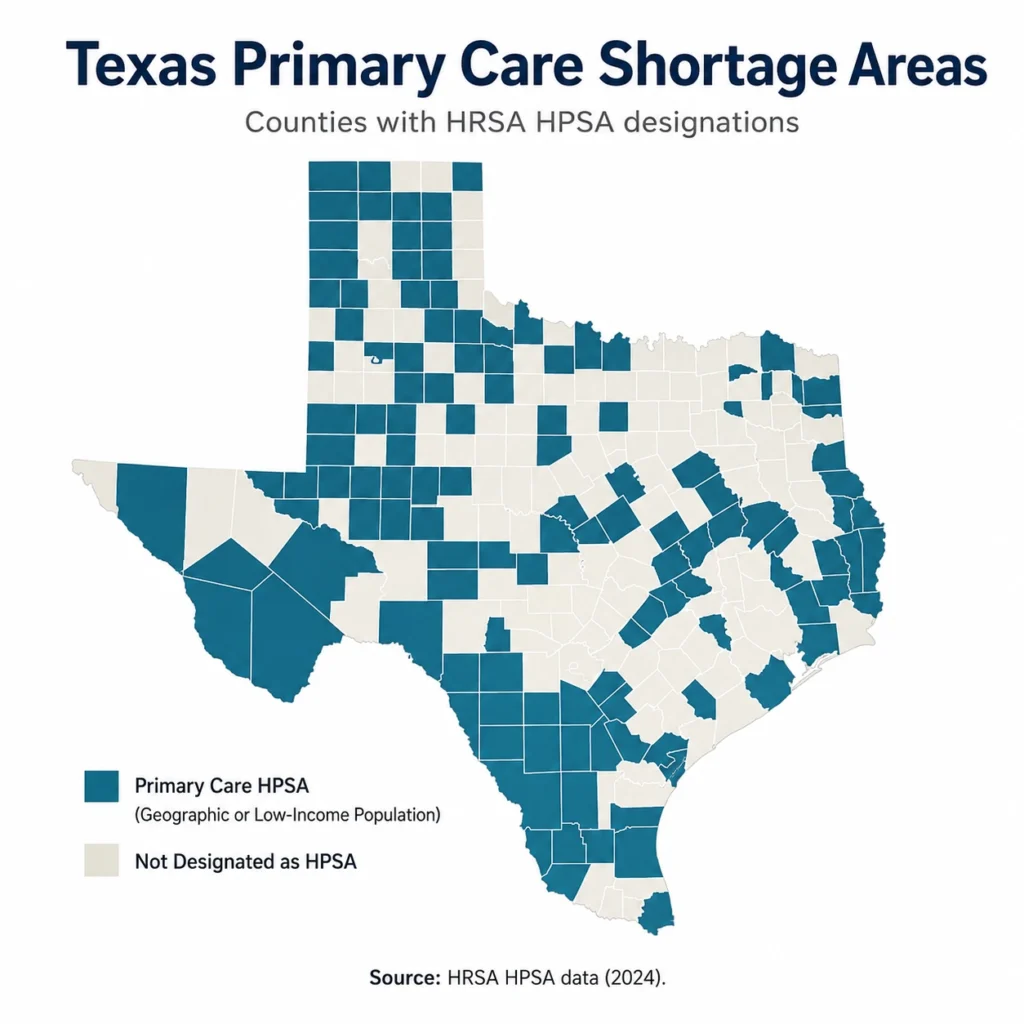
This isn’t a story about bad doctors. It’s a story about a system that asks one physician to manage two thousand patients while juggling prior authorizations, billing codes, and insurer paperwork. The Cicero Institute reports that 224 of Texas’s 254 counties are designated health professional shortage areas. That shortage hits Lubbock and Laredo as hard as it hits the rural Panhandle, and even Houston, Dallas–Fort Worth, and Austin are running out of room as the population grows.
Direct Primary Care is one response to all of this. It takes insurance out of the routine primary care equation and replaces it with a flat monthly membership paid directly to the doctor. The physician keeps a smaller patient panel, spends more time with each person, and is reachable when something comes up. It isn’t a cure-all, and it isn’t right for everyone. But for the right patient, it’s a fundamentally different experience.
What Is Direct Primary Care?
Direct Primary Care, or DPC, is a membership model. You pay your physician a flat monthly fee, and in return, you get a defined set of primary care services without anyone billing insurance for the visit itself. Because the practice doesn’t depend on insurance reimbursement, the physician doesn’t need to chase codes, claims, or prior authorizations for the care they provide you.
The clinical work looks like what you’d expect from any good primary care office, such as annual physicals, sick visits, chronic condition management, medication adjustments, preventive screenings, basic lab work, telehealth, and care coordination when you need to see a specialist. The difference isn’t what gets done. It’s how.
The whole model is built around continuity. Instead of a series of disconnected appointments, your care becomes an ongoing conversation with one doctor who knows you. Take a patient managing both high blood pressure and diabetes. In a traditional clinic, those conversations get split across short visits scattered throughout the year. For example, labs in one appointment, medication tweaks in another, dietary counseling that never quite happens because there isn’t time. In a DPC practice, a single forty-five-minute visit can cover all of it.
One important clarification: DPC is not insurance. It doesn’t cover hospital stays, emergency rooms, surgery, MRIs, or anything a specialist does. You still need real coverage for those things. That’s why a lot of self-employed Texans and small business owners pair a DPC membership with a high-deductible health plan, which means the membership handles the day-to-day, and the insurance is there for the big stuff.
How Direct Primary Care Works in Texas
Most Texas DPC practices charge somewhere between $50 and $150 per month. Pricing varies by practice, patient age, and what’s included, and each clinic sets its own structure.
Texas is an unusual place to deliver healthcare. The state has some of the best medical districts in the world, and at the same time, 224 of its 254 counties are short on primary care physicians. In stretches of West and East Texas, a routine appointment can mean ninety minutes of driving, assuming you can even get one.
Most DPC clinics are still concentrated in cities and suburbs, but the model’s low overhead has let some doctors set up in places that have been underserved for years, including Burleson, Texarkana, Beaumont, and smaller towns across Central Texas.
For patients who can reach a DPC practice, here’s what changes compared to the traditional setup:
- Same-day or next-day appointments when something acute comes up
- Visits that actually run thirty to sixty minutes when a complex problem needs it
- Direct phone, text, or message access to your doctor between visits
- Telehealth included, with no extra billing
- One physician you see every time, building real history
- A predictable monthly cost you can plan around
What’s Usually Included in a DPC Membership
Every clinic sets its own scope, so confirm the details before you sign up. That said, most Texas memberships cover a similar core.
Preventive Care
Annual wellness visits, routine screenings, blood pressure checks, weight and nutrition conversations, and the kind of lifestyle coaching that takes more than five minutes to do well. When a doctor has a smaller patient panel, preventive care stops being something that slips through the cracks. That matters most in conditions like hypertension, diabetes, and heart disease, where the complications are almost always rooted in delayed or inconsistent follow-up.
Chronic Disease Management
This is where DPC tends to earn its keep. High blood pressure, type 2 diabetes, asthma, thyroid conditions, high cholesterol, anxiety, and depression, none of these get solved in one visit. They need regular check-ins, lab review, and a doctor who notices when something has shifted. A patient with diabetes that isn’t yet under control might need to be seen four or five times a year. In a DPC practice, that’s just part of the membership, not five more copays and five more weeks of waiting.
Acute Visits
Infections, minor injuries, rashes, allergic reactions, flare-ups of a chronic condition, and the usual run of illnesses. The kinds of things you’d otherwise end up taking to urgent care.
Telehealth and Follow-up
Useful across Texas, especially where distance or a shortage of doctors makes in-person visits a logistical headache. Most practices use it for medication check-ins, minor illnesses, lab discussions, and chronic disease monitoring.
Discounted Labs, Imaging, and Medications
Many practices have negotiated wholesale pricing on common labs and generic medications and pass it through to members. Some include basic labs in the membership outright. This part varies more than anything else, so ask.
What DPC Doesn’t Cover
Understanding the limits matters as much as understanding the benefits. DPC is a primary care model, not a health plan. The following sit outside its scope:
- Emergency room visits and emergency care
- Hospital admissions
- Surgeries
- Specialist care and specialist procedures
- Advanced imaging — MRI, CT, PET
- Subspecialty work like oncology, cardiology, and orthopedics
- Major medical events, ICU care, serious trauma
Joining a DPC practice without keeping real insurance in place is a significant financial risk. One hospitalization or one surgery can wipe out years of membership savings several times over. The sensible pairing and the one most DPC patients use is a DPC membership alongside a high-deductible health plan. The membership handles your routine care; the HDHP protects you from a catastrophe.
If you’re thinking about DPC, think about it as part of a healthcare plan, not as a replacement for one.
Direct Primary Care vs. Traditional Primary Care
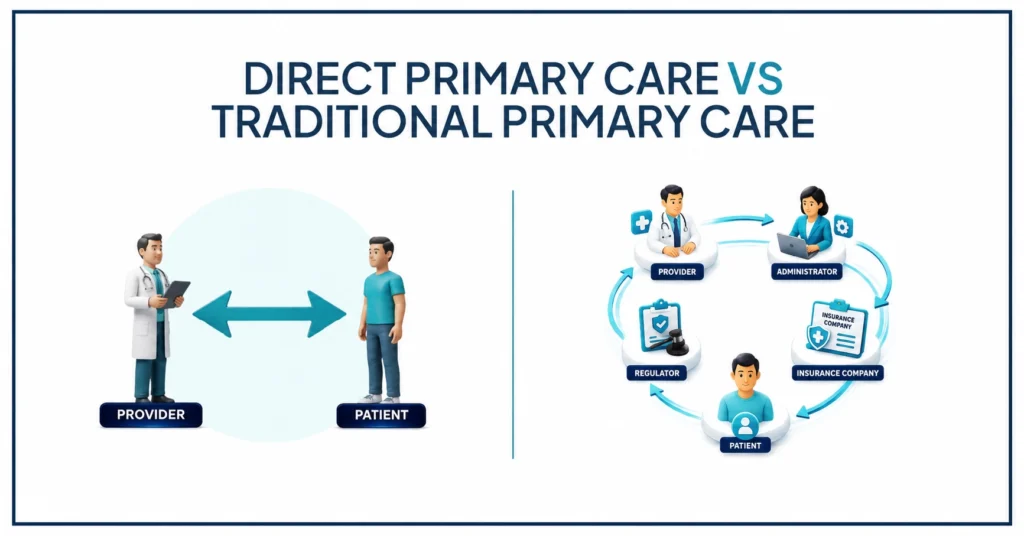
DPC doctors and traditional primary care doctors go through the same training. Same medical schools, same residencies, same licenses, same scope of practice. What’s different is the business model surrounding them, and that business model shapes almost everything about how care actually feels.
Traditional primary care is funded through insurance reimbursement, which means high volume, heavy documentation, and tight schedules just to keep the lights on. DPC funds the practice through membership fees instead, which removes the volume pressure.
| Traditional Primary Care | Direct Primary Care | |
|---|---|---|
| Revenue model | Fee-for-service insurance billing | Flat monthly membership |
| Panel size | 1,500–2,500 patients per doctor | 400–800 patients per doctor |
| Visit length | Usually 15–20 minutes | Often 30–60 minutes |
| Wait for an appointment | Days to weeks | Same-day or next-day |
| Access between visits | Nurse lines, portal messages, variable response | Direct text, call, or message to your doctor |
| Continuity | Varies; you may see whoever’s available | One physician, every time |
| Administrative overhead | Significant — coding, billing, prior auths | Minimal — no per-visit insurance billing |
| Cost predictability | Depends on plan, deductible, copays | Flat monthly fee |
Why the structural differences matter
The panel size difference isn’t a small thing. If a doctor is responsible for 2,000 patients and sees 20 a day, doing nothing else, it takes 100 working days to see each patient once. So they don’t. The schedule compresses, the documentation expands, and even an excellent physician has limited room to handle a patient’s blood pressure, their cholesterol, their medication reconciliation, the mole that wasn’t there last year, and the fact that they haven’t been sleeping, all in one visit.
A panel of 600 changes that math entirely. The physician has time to notice things such as a creeping blood pressure trend, glucose that’s drifting, a medication that isn’t sitting right, or a mood that’s shifted. Catching those early is where primary care actually earns its name.
For patients managing chronic conditions or for anyone trying to get a foothold in the crowded primary care markets of Houston or Dallas, that earlier catch can prevent a lot of expensive, avoidable trips to specialists and ERs later.
Direct Primary Care vs. Concierge Medicine
These two get confused often, and it’s worth being clear about the difference. Both involve paying a doctor directly for membership-style access, but the resemblance is mostly surface-level.
| Concierge Medicine | Direct Primary Care | |
|---|---|---|
| Annual cost | $1,500–$10,000+ | $600–$1,800 ($50–$150/month) |
| Insurance billing | Most concierge practices still bill insurance on top of the retainer | No insurance billing for covered primary care |
| Panel size | Often 300–600 patients | Working families, the self-employed, and people with high-deductible plans |
| Who it’s for | Historically aimed at high-income patients wanting premium service | Often, 300–600 patients |
| Philosophy | A premium layer added on top of insurance-based care | A replacement for the insurance billing layer in primary care |
To make it concrete: a concierge practice in Highland Park might charge $5,000 a year for enhanced access and still bill your insurance every time you walk in. You get better service, but you’re paying twice for the privilege. A DPC practice in Plano charges $95 a month for all primary care services and doesn’t bill your insurance at all for those services. The price point is built for people who couldn’t or wouldn’t pay concierge rates, like small business owners, working families, and the self-employed.
Both models care about the doctor-patient relationship. Concierge medicine is essentially a service upgrade. DPC is a structural redesign.
Who Tends to Benefit Most From DPC in Texas
DPC isn’t the right answer for every patient. A few profiles, though, tend to get real value from it.
- People with chronic conditions: High blood pressure, type 2 diabetes, hypothyroidism, and anxiety, these don’t go away. They need consistent monitoring and a doctor who’s seen you enough times to know when something is off. DPC members can come in for follow-ups without paying per visit, which makes consistent management actually doable.
- Self-employed Texans and small business owners: Texas has one of the highest self-employment rates in the country. People shopping on the individual market often end up with high-deductible plans that make every routine visit feel expensive enough to skip. A DPC membership gives you a real doctor for a predictable monthly cost, while the HDHP sits behind it for emergencies.
- Families who want one doctor for everyone: Many DPC practices offer family memberships that cover kids and adults together. For a household where someone is always coming down with something, the predictable cost and the ability to text the same doctor for a fever question at 9 p.m. takes a lot of friction out of family life.
- Patients who’ve struggled with access or communication: If you’ve spent years bouncing between providers, waiting weeks for visits, or trying to get a callback from someone who can actually help, DPC tends to feel like a different planet. And if you’re considering making the switch, changing your primary care physician is more straightforward than most people expect.
- Patients in underserved areas: DPC practices are still mostly urban, but the model’s low overhead makes it possible to run a practice in smaller communities. Where one has set up telehealth alongside in-person visits, it can meaningfully expand what’s available.
The Honest Limitations
A fair look at DPC has to include where it falls short.
- It’s an added cost. Even $60–$100 a month is real money on top of an insurance premium. For households that rarely use primary care, the math may not justify it.
- Coverage isn’t uniform across Texas. DPC clinics cluster in cities and suburbs. Rural West Texas, the Panhandle, and parts of East Texas often don’t have a practice within reasonable driving distance. DPC can’t fix the physician shortage; it can only do better where physicians already exist.
- You still need insurance. Joining DPC without solid coverage for hospitalization, emergency care, and specialist services is a serious risk. Don’t skip that step.
- It’s primary care, not a complete care plan. Patients with conditions that require heavy specialist involvement, such as active cancer treatment, advanced cardiac care, and complex rheumatology, will still spend most of their healthcare time outside the DPC practice. The model can coordinate that care, but it can’t replace it.
Is Direct Primary Care Worth It?
It depends on how much primary care you actually use.
If you see your doctor once a year for a physical and otherwise stay healthy, the membership math probably doesn’t favor DPC. But if you have hypertension, depression, pre-diabetes, or any condition that benefits from regular check-ins, the calculus changes quickly. Quarterly visits, discounted labs, the ability to message your doctor between appointments, and the early-warning effect of being known, those add up.
Take a self-employed contractor in San Antonio with a $7,000-deductible plan. Without DPC, he basically only goes to the doctor when something is wrong enough to justify paying the full visit out of pocket. With a $90 monthly membership, he has same-day access to a doctor who knows his history, labs at wholesale pricing instead of insurance-marked-up rates, and someone he can text when his blood pressure cuff at home reads high two mornings in a row. He still needs the insurance for emergencies. But primary care actually becomes something he uses.
The two questions worth asking yourself:
- How often do you actually need primary care, and is the current experience working for you?
- Does the monthly fee make sense alongside what you’re already paying for insurance?
For a lot of Texans, especially those managing chronic conditions, carrying high-deductible plans, or fed up with the rotating-doors version of primary care, the answers point toward DPC being worth a serious look.
The best next step is talking to a DPC practice directly. Ask what’s included, how the membership works alongside your insurance, and what a typical year actually looks like. If you’re still in the earlier stage of finding a primary care doctor in Texas, it helps to know what to look for before you commit to any model, DPC included.
FAQs
Does Direct Primary Care replace health insurance?
No. DPC is a primary care model, not a health plan. It doesn’t cover hospital stays, ER visits, specialist care, or major procedures. Most DPC members pair their membership with a high-deductible health plan to cover what falls outside primary care.
Is DPC available everywhere in Texas?
Practices are most common in Dallas–Fort Worth, Houston, Austin, San Antonio, and their surrounding suburbs. Coverage in rural areas is thinner, though some practices have opened in smaller communities where traditional primary care is scarce. Telehealth helps extend reach where in-person practices don’t exist.
What does DPC usually cost?
Most adult memberships in Texas run $50 to $150 per month, depending on the practice, the patient’s age, and what’s included. Many practices offer reduced rates for family members.
Is DPC the same as concierge medicine?
No. Both are membership models, but concierge practices typically charge several thousand dollars a year and still bill your insurance. DPC charges less and doesn’t bill insurance for covered primary care services.
Can families use DPC memberships?
Yes. Most practices offer individual, couple, and family plans, with pediatric care included and discounted rates for additional household members. Terms vary, so confirm with the clinic.
Is telehealth included?
Almost always. Most DPC practices include video and phone visits as part of the membership, which is especially useful in parts of Texas where the nearest clinic is a drive.
Can DPC help with chronic conditions?
Yes, this is where the model tends to shine. Hypertension, type 2 diabetes, thyroid issues, anxiety, and similar conditions benefit from regular check-ins, easy access between visits, and a doctor who knows your history.
Are labs included?
Some memberships include basic labs; others offer them at transparent wholesale pricing on top of the fee. Ask the practice for specifics.
A Final Word
Direct Primary Care doesn’t solve every problem in Texas healthcare. It doesn’t put a doctor in every rural county. It doesn’t replace specialists, surgeons, or the emergency room, all of which you’ll need at some point. And it isn’t the right financial fit for every household.
What it does offer, for the right patient, is a kind of primary care that feels almost forgotten: a doctor who knows you, has time for you, picks up when you call, and is actually paid to keep you well rather than push you through a schedule. For patients who’ve spent years navigating a system that feels indifferent, that’s not a small thing.
For a lot of Texans, it may be exactly what they’ve been looking for, and the search for one of the best primary care doctors in Texas often ends here.