Most adults in Texas see a doctor when something hurts, when a symptom won’t go away, or when life forces the issue. It’s an understandable pattern: work is busy, the kids come first, the appointment can wait, but it’s also where the model breaks down.
The diseases that cause the most serious harm don’t announce themselves. Cardiovascular disease, type 2 diabetes, hypertension, and many cancers build quietly over the years. By the time symptoms show up, the easy interventions are usually behind you. Sit-down counseling, lifestyle change, early medication, and early-stage screening catch those who are all living in the window before anything feels wrong.
Ongoing primary adult care is built for that window. It isn’t a visit. It’s a relationship with a physician who knows your history, family background, risk factors, and how your numbers have changed over time. That context is what makes prevention actually work.
Texas needs this more than most states. The North Central Texas Council of Governments has reported climbing rates of cancer, heart disease, COPD, diabetes, and other chronic illnesses across the region, most of them either preventable or significantly delayable with consistent care.
This guide walks through what comprehensive adult primary care should look like, what preventive screenings actually matter at different ages, and why a long-term physician relationship outperforms the see-a-doctor-when-something-hurts approach almost every time.
What Is Primary Adult Care?
Primary adult care is the full-picture healthcare an adult uses to stay well, not just to get patched up when something goes wrong. Your primary care physician sees you regularly, manages the moving parts of your health, orders the screenings that fit your age and risk, counsels you on what to do about them, and coordinates the rest of your care when you need a specialist or a hospital.
That’s different from urgent care, which exists to handle one-off acute problems. It’s also different from specialist care, which goes deep into a single organ system or condition. Primary care is the only part of the system that looks at the whole person and looks at you over time.
The continuity isn’t a small detail. Research has consistently found that patients with a long-term primary care relationship have lower hospitalization rates, better-managed chronic conditions, and longer life expectancy than patients without one. The reason isn’t mysterious. A doctor who has seen your numbers for five years notices when something starts to drift. A doctor seeing you for the first time has no baseline to compare against.
If you’re still in the earlier stage of finding a primary care doctor in Texas, it helps to understand what to look for before you settle on one. (And if “primary care” and “family doctor” sound interchangeable, there’s a real distinction worth understanding.)
The Annual Wellness Exam: The Foundation of Preventive Adult Care
A lot of adults think of the annual wellness visit as a quick check-in to renew prescriptions. In a rushed, volume-driven practice, that’s often what it ends up being. But a real wellness exam, if done properly, is one of the most important tools in preventive medicine, and it covers far more than most people expect.
Here’s what a thorough adult wellness exam should include.
- A full vitals review: Blood pressure, resting heart rate, respiratory rate, oxygen saturation, height, weight, and BMI, all documented and, more importantly, compared against your previous visits. The trend matters more than any single number.
- A current medical history update: Any new diagnoses since last year, surgeries, hospitalizations, new family medical history, new medications or supplements, and any symptoms — even ones you’ve been writing off as minor.
- Medication reconciliation: Every prescription, every over-the-counter medication you take regularly, every supplement. Reviewed for whether it’s still appropriate, whether the dose is right, and whether anything is interacting with anything else.
- A real health risk assessment: Not a checkbox form — a structured conversation about your lifestyle, work, stress, sleep, nutrition, physical activity, alcohol and tobacco use, sexual health, and mental wellbeing. This conversation drives which screenings are ordered and what counseling is actually prioritized.
- Preventive counseling tailored to you: Based on what the risk assessment turns up, your physician should walk you through evidence-based interventions specific to your age, sex, risk profile, and goals — not generic advice anyone could find in a brochure.
- The right screenings and labs: Ordered based on your clinical picture, not a one-size-fits-all panel.
Done well, the wellness visit is the annual reset that anchors everything else. It’s how your physician decides what’s worth screening for, what’s worth changing, and what’s worth leaving alone. It’s also where the patterns get noticed: the slow blood pressure creep, the cholesterol moving in the wrong direction, the weight that’s been quietly climbing for two years.
For patients with chronic conditions like diabetes, hypertension, heart disease, or COPD, the wellness visit sits alongside more frequent check-ins, usually every three to six months, depending on how stable things are.
Essential Preventive Screenings for Adults — by Age and Risk
Preventive screenings aren’t a universal checklist applied identically to everyone. They’re tailored recommendations driven by age, sex, family history, lifestyle factors, and existing conditions. Here are the major categories most adults need to be aware of, broadly aligned with USPSTF guidance and major medical society recommendations.
Cardiovascular Health
Blood pressure should be checked at every clinical encounter for all adults 18 and older. Hypertension affects roughly half of American adults and is among the leading drivers of heart attack and stroke. It’s also almost entirely silent as most people don’t feel high blood pressure, which is exactly why routine checking matters.
A lipid (cholesterol) panel, measuring LDL, HDL, and triglycerides, is generally recommended starting in middle age, with earlier screening for anyone carrying risk factors like obesity, smoking, diabetes, or a family history of early heart disease. The specific starting age depends on which guideline a practice follows; the practical answer is that the conversation about cardiovascular risk should be happening by your 40s at the latest.
Blood glucose and HbA1c testing matter for anyone with risk factors for type 2 diabetes, usually caused by being overweight, sedentary, having a family history, or a history of gestational diabetes.
Cancer Screenings
- Colorectal cancer screening is now recommended starting at age 45. Options include annual stool-based testing, colonoscopy every ten years, or CT colonography every five years. Each has trade-offs worth discussing with your doctor.
- Cervical cancer screening in women generally begins at age 21 with cytology (Pap) every three years. For ages 30 to 65, the current options include Pap testing every three years, Pap and HPV co-testing every five years, or primary HPV testing every five years. The right path depends on history and preference.
- Breast cancer screening with mammograms typically becomes a serious conversation in the 40s. When to start and how often depends on personal and family history; the right answer is a shared decision between you and your physician, not a fixed rule.
- Lung cancer screening with low-dose CT is recommended annually for adults 50 to 80 who have a 20-pack-year smoking history and either currently smoke or quit within the last 15 years.
- Skin cancer deserves more attention in Texas than it gets in most states. The combination of intense UV exposure and a year-round outdoor culture makes regular self-examination and physician skin checks genuinely worthwhile, especially for anyone with fair skin, a personal history of significant sun exposure, or a family history of melanoma.
Metabolic and Hormonal Health
- Thyroid testing isn’t recommended as routine screening for asymptomatic adults. It’s worth testing when there are symptoms — unexplained fatigue, weight changes, cold sensitivity, hair loss, mood shifts — or in women over 35 with a history of thyroid issues.
- Testosterone evaluation can be useful for men with symptoms suggesting low T — persistent fatigue, low libido, loss of muscle mass, or mood changes. These symptoms become more common after 40 and are frequently underdiagnosed because they overlap with so many other conditions.
- Obesity and BMI are part of every wellness visit, but a structured weight assessment becomes more important once BMI crosses 30 — the threshold where metabolic risk meaningfully affects cardiovascular health, diabetes risk, joint health, and mental well-being.
Other Important Screenings
Vision and hearing checks are easy to skip and easy to underestimate. Both significantly affect quality of life, and both decline gradually enough that you don’t notice until you do.
STI and HIV screening are recommended as routine preventive care for sexually active adults aged 13 to 64.
Bone density (DEXA) scans are standard for women 65 and older, and earlier for postmenopausal women with risk factors like low body weight, smoking, long-term steroid use, or rheumatoid arthritis.
Adult Immunizations: The Preventive Step Most Adults Overlook
One of the most common assumptions in adult healthcare is that vaccines are mostly for kids. They aren’t. Vaccine-preventable illness in adults still drives significant hospitalization and death every year, and most adults have no idea which ones they’re behind on.
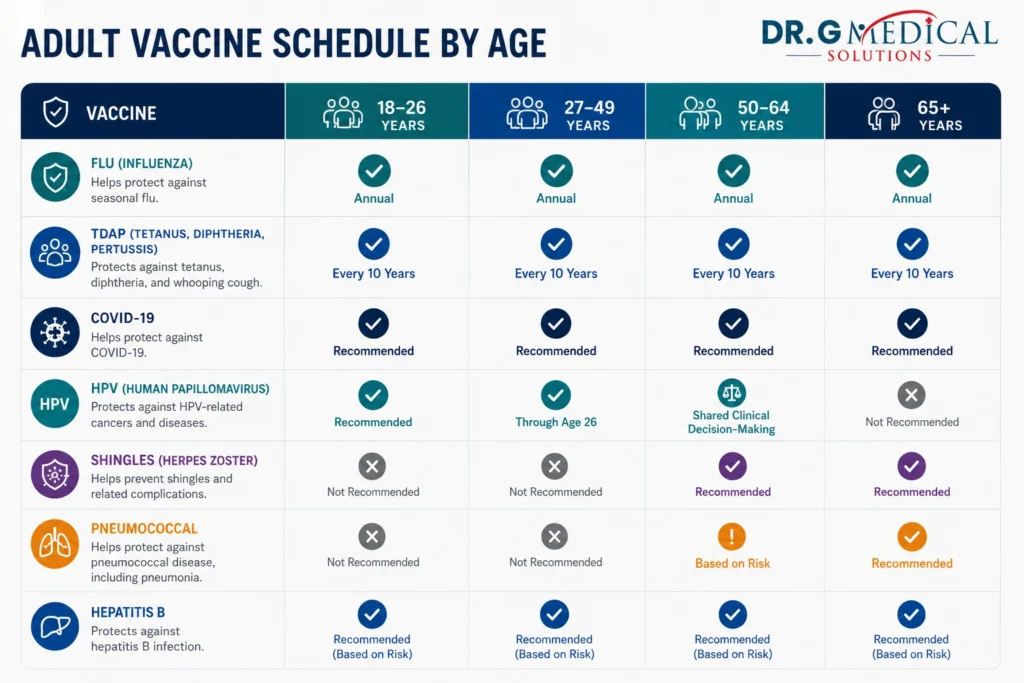
A good primary care practice tracks your immunization record and identifies gaps at every visit. The current adult schedule (per CDC guidance) generally includes:
- Flu vaccine every year
- Tdap booster every ten years for tetanus, diphtheria, and pertussis
- COVID-19 boosters per current guidance for eligible adults
- Shingrix (shingles) for adults 50 and older — two doses
- Pneumococcal vaccine for adults 65 and older, and for younger adults with diabetes, chronic lung or heart disease, or immunocompromising conditions
- Hepatitis B series for adults who weren’t vaccinated in childhood or can’t document immunity
- HPV vaccine routinely through age 26, and through shared decision-making for adults 27 to 45
Travel and regional exposures matter too. Hepatitis A and meningococcal vaccines come up for travelers, and physicians in Texas should be paying attention to mosquito-borne risks like West Nile virus in certain parts of the state.
Chronic Disease Prevention: Getting Ahead of Texas’s Leading Health Threats
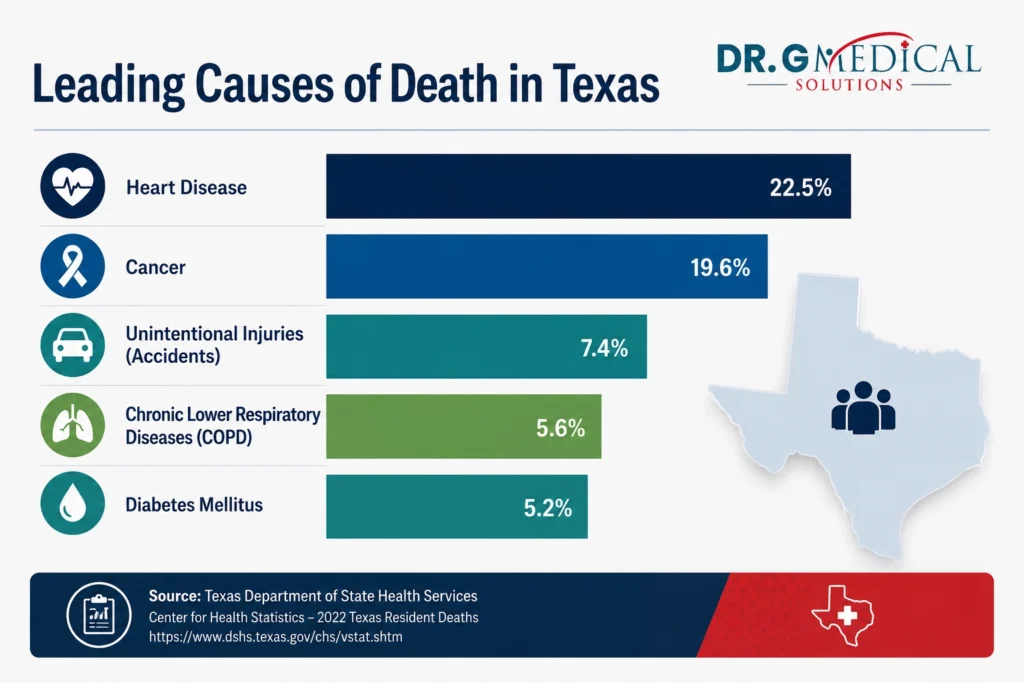
Texas carries a heavy and largely preventable chronic disease burden. According to the CDC, the leading causes of death in Texas include heart disease, cancer, accidents, chronic lower respiratory disease, and diabetes, and primary care has a direct hand in chronic disease management.
Diabetes Prevention
The CDC currently estimates that more than 115 million American adults have prediabetes, and roughly eight in ten of them don’t know it. Most will eventually progress to type 2 diabetes if nothing changes.
The good news is that prediabetes is one of the most reversible conditions in adult medicine. A combination of nutrition changes, regular physical activity, and modest weight loss can cut the risk of progression in half. For higher-risk patients, medications like metformin are sometimes part of the plan. The earlier this conversation starts, the more options stay on the table.
Cardiovascular Disease Prevention
Heart disease remains the number one cause of death in Texas and in the country. Primary prevention, keeping a first cardiac event from ever happening, is one of the most measurable wins primary care offers. It works through a combination of blood pressure control, cholesterol management, diabetes care, weight and lifestyle support, and smoking cessation.
For most adults with hypertension, the target is a blood pressure under 130/80. Getting there is rarely about one big intervention. It’s about regular monitoring, medication adjustments when needed, conversations about diet and exercise, and ongoing support like the kind of incremental work that only really happens in a continuous care relationship. The payoff is significant: meaningfully lower risk of stroke, heart attack, kidney disease, and heart failure.
Obesity and Weight Management
Obesity isn’t a willpower problem. It’s the result of genetics, hormones, environment, food culture, sleep, stress, and how the body manages reward, all colliding. Treating it as a moral issue is one of the reasons it’s so poorly addressed in traditional care.
Primary care evaluates weight through the lens of metabolic risk: what’s it doing to your cardiovascular system, your insulin sensitivity, your joints, your sleep, your mental health? Newer medications such as GLP-1 receptor agonists like semaglutide have meaningfully changed what’s possible for many patients, with strong outcomes for both weight management and cardiovascular risk. But medication is one piece of a broader framework that still includes behavioral support, nutrition, and consistent follow-up.
COPD and Respiratory Health
Chronic obstructive pulmonary disease is significantly underdiagnosed in Texas, particularly in long-term smokers who chalk up shortness of breath to aging or being out of shape. A simple in-office breathing test, such as spirometry, can catch obstructive lung disease early, when intervention actually makes a difference in how the rest of your life plays out.
Mental and Behavioral Health
Physical health and mental health aren’t separate systems. They’re deeply connected, and any preventive care plan that ignores one is incomplete.
Chronic stress, anxiety, depression, burnout, and sleep disorders all affect cardiovascular health, immune function, digestion, hormone balance, and energy. The reverse is also true, meaning chronic physical conditions reliably affect mood, sleep, and cognitive function. Most adults still hesitate to bring up mental health with a primary care doctor, often assuming PCPs only deal with what they can put on a lab slip.
Good primary care doesn’t work that way. The wellness visit is one of the most natural places to flag patterns like sleep that’s been off for months, a slow drift toward exhaustion, the kind of low-grade anxiety that’s quietly reshaping daily life, and to build a plan that may include lifestyle changes, stress management strategies, therapy referrals, medication, or some combination. The goal isn’t to medicalize normal life. It’s to treat the whole person, because the whole person is what shows up at every visit anyway.
Medication Management: The Overlooked Safety Issue in Adult Care
By the time most adults reach their 40s and 50s, they’re often carrying prescriptions from a handful of different sources, including a cardiologist, an endocrinologist, a dermatologist, maybe one from an urgent care visit a year ago that never got reviewed again.
When no one is actively managing the whole list, the risks compound quickly. Duplicate therapies. Doses that haven’t been reassessed in years. Drug interactions that nobody flagged. Medications that are no longer doing what they were started for.
A real primary care visit includes a full medication reconciliation:
- Every prescription medication, with dose and frequency
- Every regular over-the-counter medication, such as NSAIDs, antihistamines, and antacids, quietly adds up
- Every supplement and herbal, which can interact with prescriptions, more than most patients realize
- A direct, honest conversation about whether you’re actually taking everything as prescribed, and if not, what’s getting in the way
Telehealth has made this easier, especially for patients managing hypertension or diabetes who need more frequent medication check-ins without driving to the office every time.
How Often Should Adults See Their Primary Care Doctor?
It depends, but the general framework is straightforward.
Healthy adults under 50 generally need a comprehensive wellness visit once a year. Adults managing one or more chronic conditions usually need to be seen every three to six months for labs, medication adjustments, and progress reviews. Adults over 65 typically need more frequent visits because both the conditions and the medications get more complicated to manage as life goes on.
Telehealth follow-ups and remote patient monitoring have made consistent contact much easier, particularly for patients in rural East Texas or anywhere the nearest clinic is a drive. You don’t need to be in the office for everything anymore.
The single most important point: don’t wait for symptoms. The whole point of preventive care is doing the work before anything starts to feel wrong. And if you currently have a primary care doctor but the relationship isn’t working because of long waits, rushed visits, or the sense that no one really knows your history, changing your primary care physician is more straightforward than most people expect.

FAQs
What does primary adult care include?
Annual wellness exams, preventive screenings, immunizations, chronic disease management, mental health support, medication management, lifestyle counseling, and specialist coordination when needed. It’s a continuous relationship, not a series of one-off visits.
What are the benefits of preventive care?
Earlier detection of disease, lower long-term costs, better management of chronic conditions, fewer hospitalizations, and a meaningfully better quality of life over time. Most of the value comes from catching things early, when they’re still easy to address.
What preventive screenings should adults get every year?
Blood pressure at every visit, and an annual review of which screenings are due based on age, sex, family history, and risk factors. The specifics, like cholesterol panels, blood glucose, cancer screenings, and immunizations, vary by patient.
How is primary care different from urgent care?
Urgent care handles immediate, non-emergency problems, including a sprain, a sinus infection, and a cut that needs stitches. Primary care is the ongoing relationship that covers prevention, chronic disease management, and coordination of everything else. The two complement each other; they don’t replace each other.
Do I need a primary care doctor or a specialist?
Start with primary care. Your PCP can evaluate the issue, manage what’s manageable, and refer you to the right specialist with the right information when one is needed. That coordination is one of the most valuable things primary care does.
What is a biopsychosocial approach to primary care?
It’s the recognition that health is shaped by biological, psychological, and social factors all at once. A physician practicing this way doesn’t treat a lab result in isolation but actually treats a person in full context.
The Bottom Line
Preventive adult care isn’t a single visit or a yearly checkbox. It’s a sustained, individualized effort that works because someone is paying attention to you over time.
The screenings, the vaccines, the chronic disease conversations, the mental health check-ins, the medication reviews, none of these are standalone events. They’re chapters in an ongoing clinical story, and the value compounds when one physician is writing it with you year after year.
If you’re an adult in Texas without a steady primary care relationship, or if it’s been more than a year since your last wellness visit, that’s where to start. Not because something is wrong. Because preventing something from going wrong is exactly the point.
For patients looking for that kind of long-term continuity, it’s also worth understanding the membership-based primary care model now growing across Texas, and how it changes what an ongoing physician relationship can look like.