Changing your primary care doctor isn’t a big deal, but most people delay it longer than they should.
Sometimes it’s obvious. You feel rushed during visits. You don’t get clear answers. It’s hard to get an appointment when you actually need one. Other times, it’s just a feeling that something isn’t right, but you keep putting it off because switching doctors sounds complicated.
In Texas, it’s actually pretty straightforward. There’s no formal “transfer process” in most cases. You’re not locked in, and you can choose a different primary care physician whenever you want. The only thing that really matters is how you go about it, so nothing gets disrupted in your care.
Why You Might Need to Switch Your Primary Care Doctor
Multiple practical and medical concerns guide patients toward changing and choosing their primary care physician (PCP). This choice usually builds gradually as individuals sense their current care fails to meet health goals, expectations, or lifestyle needs.
- Key issues include weak communication and low trust in the patient–doctor bond, which harms care quality and final results. Patients often feel ignored, hurried, or not taken seriously, which directly affects treatment quality, long-term health progress, and overall risk levels.
- Relocation or moving into a new area creates a need for a new local provider to maintain continuity of care services within the ongoing treatment transition period process. In many cases, insurance changes push patients to change primary care physicians due to network restrictions that apply.
- Insurance network updates stay important since plan changes may require patients to choose a new in-network provider under HMO or PPO rules, helping control total out-of-pocket expenses.
- Patients often move on due to long waiting periods or low availability, which slows treatment and affects access to timely care.
Some people also look for advanced treatment or stronger chronic care management, leading them to select a provider that fits long-term health plans and personal needs.
How the Process Works in Texas
There isn’t a formal cancellation process for most primary care providers. You don’t need permission from your current doctor to switch. What usually happens is simple:
- You find a new primary care doctor, book your first appointment, and start care there. That’s it.
- The only part that needs a bit of attention is your medical records. If you’ve had tests, diagnoses, or ongoing treatment, you’ll want that information transferred so you don’t have to start from scratch.
Most clinics in Texas handle this routinely. You’ll just sign a release form, and they’ll request your records from your previous provider.
Step-by-Step: Changing Your Primary Care Physician in Texas
Switching your primary care physician becomes much easier when you follow a structured process.
1. Find a New Primary Care Provider
The first step in how to switch primary care doctors is identifying the right provider who matches your medical needs and insurance coverage. What you can do is:
- Check your insurance directory for in-network providers
- Compare clinics based on location, availability, and services
- Review patient feedback and care approach
- Look for providers offering preventive and long-term care support
A well-matched primary care specialist improves primary care access and strengthens your long-term health outcomes.
2. Confirm Insurance Coverage
Before making any switch, verify your insurance details carefully to avoid surprise costs or claim issues. Check key points like the difference between HMO and PPO plans, and confirm the provider is in-network. Review copayments, deductibles, and referral rules. Also, check coverage for specialist visits when required.
Understanding doctor switching insurance rules ensures your new provider is fully accessible within your plan.
3. Schedule Your First Appointment
Once your new provider is selected, book your first visit strategically to ensure a smooth transition. Important steps:
- Schedule a new patient primary care appointment
- Avoid gaps in ongoing treatments or prescriptions
- Ask about the onboarding process and intake requirements
- Share basic medical concerns in advance if needed
This step helps establish early patient-doctor relationship alignment and reduces future confusion.
4. Request Medical Records Transfer
Your medical history is one of the most important parts of switching doctors. Without it, your new physician may lack critical context for your care. You need to complete a HIPAA medical records release form. Request full transfer of lab reports, prescriptions, imaging results, and medical history notes.
Ensure records are sent directly to the new provider. This is a key part of medical records transfer to a new doctor and ensures accurate treatment decisions.
Most providers use Electronic Health Records (EHR) systems, which allow faster and more secure transfers while maintaining compliance under HIPAA regulations.
5. Transition Your Care Smoothly
After switching providers, the focus shifts to maintaining uninterrupted care and aligning treatment plans. Steps to follow:
- Review your current and past treatment plans
- Update medications and prescriptions with the new doctor
- Discuss chronic conditions or ongoing concerns
- Confirm future screenings or preventive care schedules
A smooth transition ensures true continuity of care and helps your new physician build a complete understanding of your health profile.
What to Know About Insurance Before Switching Doctors in Texas
When you switch your primary care doctor in Texas, you usually also update your new choice with your insurance provider. In most cases, this is done through your insurance account online or through their app, where you simply select a new in-network doctor.
The important thing is making sure your new doctor is covered under your plan so there are no billing issues later. Once updated, the change usually takes effect from the next cycle or billing period.
If anything is unclear, insurance providers usually guide you through it fairly quickly.
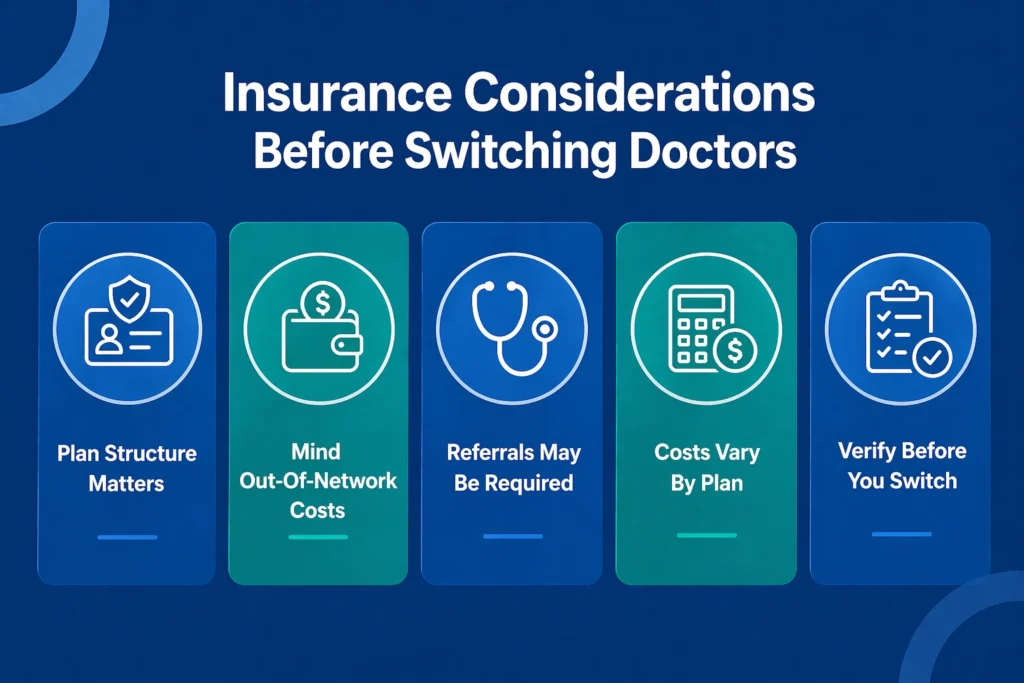
1. HMO vs PPO Plan Structure
Under HMO plans, patients usually choose an in-network primary care doctor who manages their care and handles referrals. PPO plans tend to be more flexible, as you can see specialists without referrals, but you’ll usually pay more for that flexibility. If you’ve ever compared insurance plans on Healthcare.gov, it’s essentially the same trade-off between control and cost.
2. Out-Of-Network Costs
Visiting a doctor outside the insurance network can significantly raise out-of-pocket expenses levels increase. PPO plans may partially cover these visits, while HMOs often do not cover them at all except emergencies cases.
3. Specialist Access and Referrals
Specialist reliance makes your plan greatly important. HMO plans often require referral from a PCP before seeing a specialist, which can delay the care services approval process.
4. Copays, Deductibles, and Cost Variations
Costs can vary depending on the provider and plan type. HMOs usually have lower premiums and predictable copays, while PPOs may have higher premiums but give more provider choice.
5. Coverage Verification Before Switching
Confirm that your new doctor belongs to your in-network provider under your current plan coverage. Provider networks differ even inside the same insurance company, so direct verification stays essential important step.
Questions to Ask Before Choosing a New Doctor
Before finalizing your new PCP, ask:
- Are you accepting new patients?
- Do you accept my insurance plan?
- How do you handle emergency care?
- What is your appointment availability?
- How do you communicate with patients?
- Do you offer telehealth services?
These questions help evaluate the quality of the patient-doctor relationship.
How to Transfer Medical Records Safely
Transferring your medical records ensures your new doctor has complete and accurate health information for proper diagnosis and treatment. Steps include:
- Sign a HIPAA authorization form to legally release your records
- Request full or specific medical history from your current provider
- Choose electronic or paper transfer based on availability
- Allow 7–30 days for processing and delivery
- Confirm your new doctor has received all records
Under the Health Insurance Portability and Accountability Act, you have the right to access and transfer your health data securely.
Many providers use Electronic Health Records (EHR) systems, making transfers faster and more efficient.
Common Mistakes to Avoid When Switching Doctors
Avoid these errors when changing your PCP:
- Not checking insurance before switching
- Waiting until prescriptions run out
- Not requesting full medical history
- Choosing a doctor without research
- Ignoring follow-up continuity of care
Avoiding these ensures a smooth healthcare provider transition.
Switching to DR. G Medical Solutions
A lot of patients who switch are simply looking for something more consistent and easier to deal with.
At DR. G Medical Solutions, the focus is on making care feel easy again. Appointments aren’t meant to feel rushed, and the goal is to actually understand what’s going on rather than just handle the immediate concern and move on.
Dr. Andrew Gulbis provides coordinated primary care services centered on easy access to care, long-term health planning, and smooth transfer between providers.
If you’re switching from another provider, the process is handled step by step. Records can be requested on your behalf, and the first visit is used to get a clear picture of your health so care continues without interruption. This switch tends to work well for people who:
- Want more time during appointments
- Prefer clear, direct communication
- Need consistent follow-up care
- Are tired of dealing with long scheduling delays
If your current setup hasn’t been working, changing providers is often simpler than it seems, and usually worth it.
Thinking of Changing Your Primary Care Doctor in Texas?
If your current setup hasn’t been working, it might be worth speaking to a provider who takes the time to understand your situation properly. At DR, G Medical Solutions, care is kept simple—clear communication, easier access, and a more consistent experience.
Book Your AppointmentFAQs
Can I Switch My Primary Care Doctor Anytime in Texas?
Yes, you can switch your primary care doctor anytime, but insurance rules and provider availability may affect how quickly the transition happens.
Do I Need to Tell My Old Doctor I Am Leaving?
It is not required, but informing your previous doctor helps ensure proper communication, smoother medical records transfer, and better continuity of care.
Will my medical records transfer automatically?
No, but it’s easy to request them. Your new clinic will usually guide you through it.
How long does it take to switch?
In most cases, just a few days to a couple of weeks, depending on appointment availability and record transfer.
Final Takeaway
Changing doctors is not a complicated process in Texas, but choosing the right one still takes a bit of thought.
By now, you have a clear process to take control of how your healthcare works for you.
For patients who want a smoother, more coordinated experience, DR. G Medical Solutions provides structured support throughout the transition, helping you move forward with confidence, not uncertainty.
A smooth transition ensures better continuity of care, improved communication, and stronger long-term health outcomes.